6 min read
RAG, Explained Like You're Not a Machine Learning PhD
Retrieval-Augmented Generation sounds like a Transformer villain. It's actually just an AI that's learned to Google things before answering — and it might be the single most useful trick in modern AI.
Picture the smartest friend you have. Brilliant, well-read, can explain almost anything off the top of their head. There's just one catch: they haven't left the house, read a book, or checked their phone since sometime last year — and instead of ever saying "I don't know," they'll confidently make something up that sounds exactly right. That friend is a plain large language model. RAG is what happens when you hand that friend a phone and say, "hey, maybe look this up first."
Okay but what does RAG actually stand for
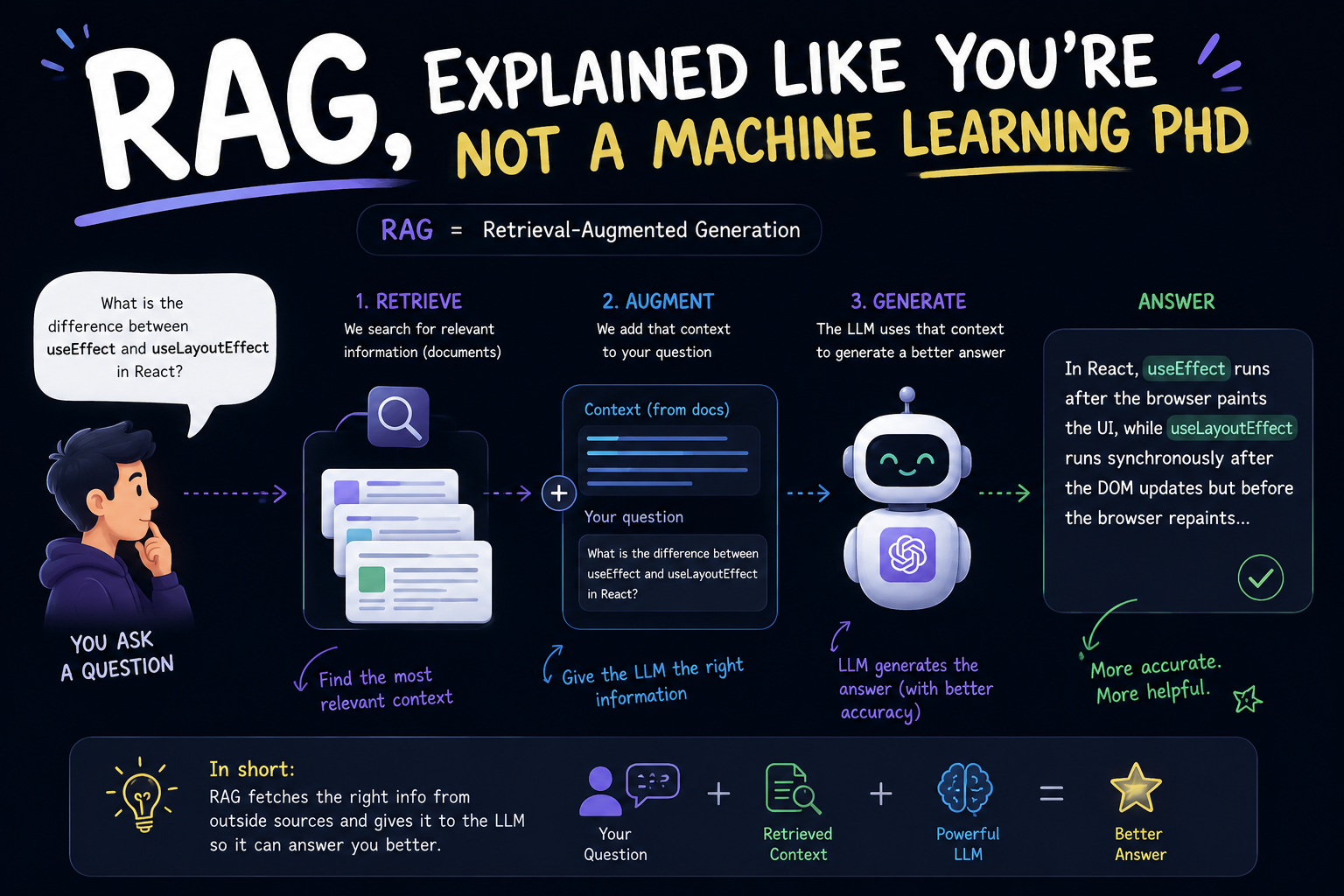
Retrieval-Augmented Generation. Three intimidating words for a genuinely simple idea: before the AI writes its answer, a separate system goes and fetches some relevant, up-to-date information, and slips it into the AI's context so it has real material to work from — instead of relying purely on whatever it memorized during training, months or years ago.
Without RAG
Ask a plain model "what's our current refund policy?" and it will happily invent one. It won't sound uncertain. It won't hedge. It'll just be wrong, with total confidence — the AI equivalent of a friend answering a trivia question they clearly don't know, but in a tone that dares you to fact-check them.
The problem RAG is quietly solving
Language models have two chronic issues. First, they're frozen in time — trained on a snapshot of the internet up to some cutoff date, so anything newer than that is a blind spot. Second, they don't know your stuff — your company's internal docs, your product's actual pricing, that one PDF you need answered questions about. Retraining a giant model every time a document changes would be absurdly slow and expensive. RAG sidesteps the whole problem: don't retrain the model, just hand it the right paragraph at question time.
How it works, in four unscary steps
- You ask a question. "What's included in the Pro plan?"
- The system searches a knowledge base — your docs, a database, a pile of PDFs — for the chunks of text most relevant to your question. This is the "Retrieval" part, and it's usually powered by something called vector search, which is really just a clever way of measuring "how similar is this meaning to that meaning."
- Those chunks get glued into the prompt, right alongside your question, basically saying to the model: "here's some real material — use this to answer."
- The model writes the answer — the "Generation" part — grounded in text that's actually true and actually current, instead of vibes from training data.
That's genuinely the whole trick. No new model, no retraining, no PhD required — just search, then write.
The analogy that makes it click
A plain LLM takes a closed-book exam, from memory. A RAG system takes an open-book exam — and gets to pick which book.
The whole concept in one sentence
A closed-book student who half-remembers the material will still write a confident, fluent-sounding answer — it just might be wrong. An open-book student, even a less brilliant one, can flip to the right page and quote it directly. RAG turns your AI into the open-book student, every single time.
"Why not just fine-tune the model instead?"
Fair question — fine-tuning (further training the model on your own data) is the other big way to customize an AI. They solve different problems, and most real systems that need both actually only need one of them:
| RAG | Fine-tuning | |
|---|---|---|
| Best for | Giving the model fresh facts and specific documents | Teaching the model a new style, tone, or skill |
| Update speed | Instant — just change the documents | Slow — requires retraining |
| Cost | Relatively cheap | Can get expensive, especially at scale |
| Can cite its source? | Yes — it can point at the exact chunk it used | No — knowledge gets baked in, untraceable |
| Fixes hallucinations about facts? | Yes, mostly | Not really — it still guesses when unsure |
Rule of thumb: if the problem is "the model doesn't know this fact," reach for RAG. If the problem is "the model doesn't behave the way I want," that's more of a fine-tuning question.
You've almost certainly already used RAG
- Asked an AI assistant a question and watched it "search the web" before answering — that's RAG with the internet as the knowledge base.
- Uploaded a PDF to a chatbot and asked "what does this contract say about termination?" — that's RAG with your file as the knowledge base.
- Used a customer support chatbot that somehow knows your specific order details — RAG, pulling from a live database.
- Used a coding assistant that searches your codebase before answering a question about it (hi) — same idea, code as the knowledge base.
Where RAG can still faceplant
RAG is a huge upgrade, not a magic wand. It inherits a very old computer-science problem: garbage in, garbage out.
- Bad retrieval, bad answer. If the search step grabs the wrong paragraph, the model will confidently build a great answer out of the wrong material.
- Outdated or messy source documents in, outdated or messy answers out — RAG can't fact-check your own knowledge base for you.
- Too much stuffed-in context can bury the actually-relevant sentence in noise, and the model loses the thread.
- It still won't reliably say "I don't know" just because you gave it better material — good prompting still has to ask for that explicitly.
So no, RAG doesn't make a model smarter. What it does is make the model better-read — and for most real questions, being well-read beats being clever every single time.