7 min read
AI Engineering, Demystified: What the Job Actually Is (and Isn't)
Somewhere between 'I called an API' and 'I trained a neural network from scratch' lives an entire discipline nobody agreed on a definition for. Let's fix that — with fewer buzzwords than usual.
Two years ago, "AI Engineer" wasn't really a job title. Now it's on half the résumés in tech, right next to people who, a year prior, were doing something else entirely and one weekend hackathon later had a new LinkedIn headline. That's not a jab — it's just how fast this discipline materialized. So let's do the unglamorous but useful thing: actually define it.
What an AI engineer is not
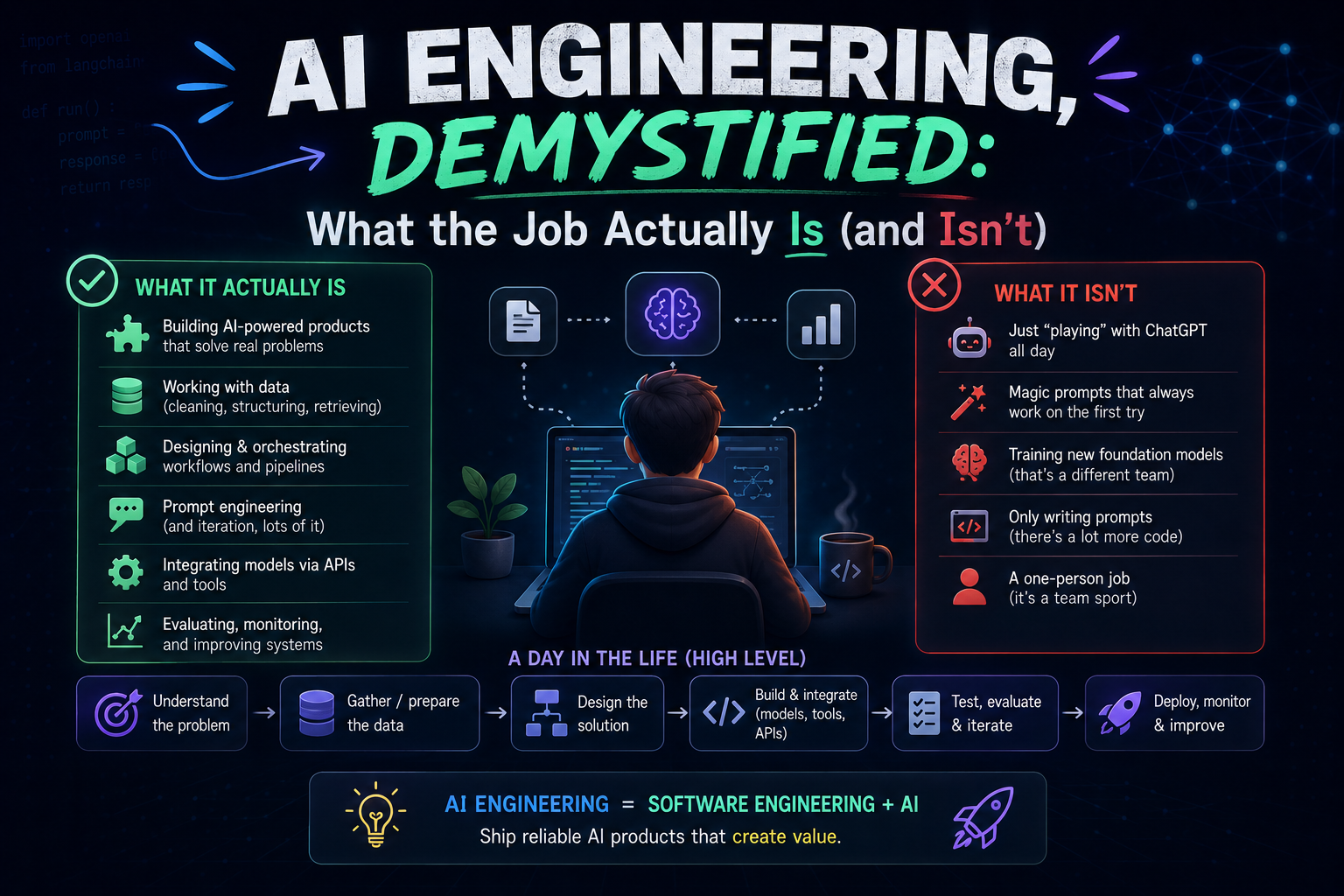
Let's clear the fog first. An AI engineer is not the person training GPT-scale models from scratch on a cluster of GPUs the size of a small country's power grid. That's a machine learning researcher or ML infrastructure engineer — a real, different, extremely math-heavy job. An AI engineer also isn't just "someone who uses ChatGPT a lot," flattering as that self-assessment might be.
The honest definition
An AI engineer is a software engineer who builds products on top of existing foundation models — via APIs, not from-scratch training — and treats prompts, retrieval, evaluation, and guardrails as first-class engineering problems, not afterthoughts.
AI engineer vs. ML engineer: a field guide
| ML Engineer | AI Engineer | |
|---|---|---|
| Primary artifact | Trains and ships a model | Ships a product built on someone else's model |
| Main tool | PyTorch, GPU clusters, training runs | APIs, prompts, retrieval pipelines, evals |
| Timeline to ship | Months, sometimes years | Days to weeks |
| Biggest risk | The model doesn't converge | The model confidently lies and nobody notices |
| Math you actually use day-to-day | A lot | Less than you'd think — more systems thinking than linear algebra |
Neither one is "easier." They're just solving different problems — one makes the engine, the other builds the car, dashboard, brakes, and the seatbelt that stops it lying to you about the speed limit.
What an AI engineer actually builds
- Prompt systems — not "typing nicely at a chatbot," but versioned, tested, reviewable prompt templates that behave predictably under real user input, not just the three examples that worked in the demo.
- Retrieval pipelines — RAG, in other words: making sure the model answers from real, current, relevant material instead of confident memory.
- Agents and tool use — wiring a model up to actually do things (search, run code, call an API) instead of just describing what it would do if it could.
- Evaluation harnesses — the unglamorous, unskippable part: a repeatable way to measure whether a prompt or pipeline change made things better or quietly made them worse.
- Guardrails and safety filters — catching the outputs you really don't want reaching a user, before they reach a user.
- Observability — logging, tracing, and cost monitoring for a system whose failures are often silent and don't throw a stack trace.
A day in the life, roughly
- Discover a prompt tweak that fixed one edge case broke three others you weren't testing for.
- Argue, internally, about whether a bug is "the model's fault" or "my fault for not constraining it better." (It's usually the second one.)
- Watch the monthly API bill and quietly reconsider whether the app needs quite so much context per request.
- Explain to a stakeholder that "it worked when I tried it" is not the same thing as "it's ready to ship."
- Add one more eval case to the regression suite, sworn to be the last one. It will not be the last one.
The toolbox, without the hype
- Vector databases — for the retrieval half of RAG (Pinecone, pgvector, Chroma, and friends).
- Orchestration frameworks — LangChain, LlamaIndex, or increasingly, just well-organized plain code, once the framework's magic stops matching the mental model.
- Eval frameworks — for turning "seems better?" into an actual, repeatable score.
- Prompt/version management — because a prompt that changes with zero review process is just untested code with extra steps.
- The humble system prompt — still, somehow, one of the highest-leverage files in the entire codebase.
Skills that actually move the needle
Here's the professionally reassuring part: the highest-leverage skill in AI engineering isn't a PhD in transformers. It's regular, disciplined software engineering — applied to a component that happens to be probabilistic instead of deterministic.
- Writing clear specs — for a model, not just for a teammate.
- Treating evaluation as testing, not an afterthought.
- System design: caching, retries, fallbacks, cost control — the boring stuff that determines whether something survives contact with real users.
- Genuine curiosity about why a model failed, instead of poking the prompt randomly until it stops.
- Product sense — knowing which 20% of "AI-powered" ideas are actually worth building.
AI engineering is roughly 10% prompting and 90% software engineering nobody warned you about.
The truest sentence in this post
So if you're a software engineer wondering whether you need to go back to school to work in AI: probably not. You need the same rigor you already have, pointed at a new kind of unreliable dependency — one that talks back, occasionally lies with total confidence, and never once says "I'm not sure." Welcome to the field. Bring your testing discipline; leave the buzzwords at the door.